Printed circuit boards and their assemblies (PCB & PCBA) are the core components of electronic products, and their reliability directly determines the overall reliability of electronic products. To ensure and enhance the quality and reliability of electronic products, it is essential to carry out comprehensive physical and chemical analyses of failures, identify the underlying failure mechanisms, and then propose corresponding improvement measures. MTT possesses profound technical expertise in board-level failure analysis, a complete range of analytical methods, a vast database of case studies, and a team of experienced experts, providing you with high-quality and efficient failure analysis services.
The purpose of electronic component failure analysis is to employ a variety of testing and analytical techniques and procedures to identify the failure phenomena of electronic components, determine their failure modes and mechanisms, identify the ultimate root cause of failure, and propose recommendations for improvements in design and manufacturing processes. This helps prevent the recurrence of failures and improves the overall reliability of the components.
The continuous rise in complexity and performance requirements of integrated circuits, combined with potential risks across design, manufacturing, packaging, and application stages, has led to frequent occurrences of critical failure modes such as short circuits, open circuits, leakage, burnout, and parameter drift. These issues not only result in costly device scrapping and system downtime but also often trigger disputes over responsibility among designers, foundries, packaging and testing houses, and end-users, causing significant economic losses and reputational risks.
The performance requirements for polymer materials continue to rise, while differences in understanding of high-demand products and processes between customers and suppliers often lead to frequent failures such as fracture, cracking, corrosion, and discoloration. These failures frequently cause disputes over responsibility and result in significant economic losses.
The increasingly harsh service environments of metal components place higher demands on material performance and structural reliability. However, factors such as design flaws, material defects, manufacturing deviations, or improper use can readily trigger typical failures including fatigue fracture, stress corrosion cracking, hydrogen embrittlement, creep, wear, and overload deformation.
Didn't find what you were looking for?
Consult a professional engineer immediately for your service

Didn't find what you were looking for?
Consult a professional engineer immediately for your service
Meixin Testing leverages its technological edge in constructing massive failure databases, showcasing its capabilities through comprehensive case studies, solutions for complex scenarios, partnerships with leading enterprises, and systematic intellectual property. Drawing on millions of failure analyses, it delivers precise insights into root causes, enabling inspection reports to provide robust support for clients' quality upgrades and achieve zero failures.
Didn't find what you were looking for?
Consult a professional engineer immediately for your service

Stay updated with the latest news from Maxin Testing, including technical developments, exhibitions, and events. We build on a foundation of professional testing to deliver customized solutions for our clients, ensuring quality control from the source. This empowers our clients to stand out in the marketplace and achieve commercial success.
Didn't find what you were looking for?
Consult a professional engineer immediately for your service

MTT is a nationally accredited commercial third-party laboratory. We specialize in providing testing services, technical consulting services, and solution services to clients across industries including electronics manufacturing, automotive electronics, semiconductors, and aerospace materials.
Maxin Testing operates laboratory facilities in Shenzhen, Suzhou, and Beijing, featuring multidisciplinary testing and analytical laboratories. The company pioneers an industrial hospital service model grounded in materials science engineering and electronic reliability engineering.
Didn't find what you were looking for?
Consult a professional engineer immediately for your service
Professional verification platform, delivering precise data insights to build a solid foundation of trust for investors.
Didn't find what you were looking for?
Consult a professional engineer immediately for your service
Why did my IMC layer fail again with the same solder?
Release date: 2025-03-26 00:00
Share to:

After a PCBA patch, the hot pressure welded end wire is lightly pulled off, and the capacitor/resistance component will also drop slightly. The unwelded same batch of SET board has tin undesirable. A series of test analyses of 3pcs failure samples are now being carried out to find the root cause of poor PCBA solder joint welding.


1. Appearance inspection

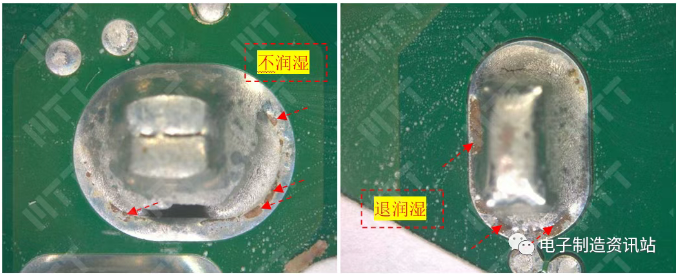
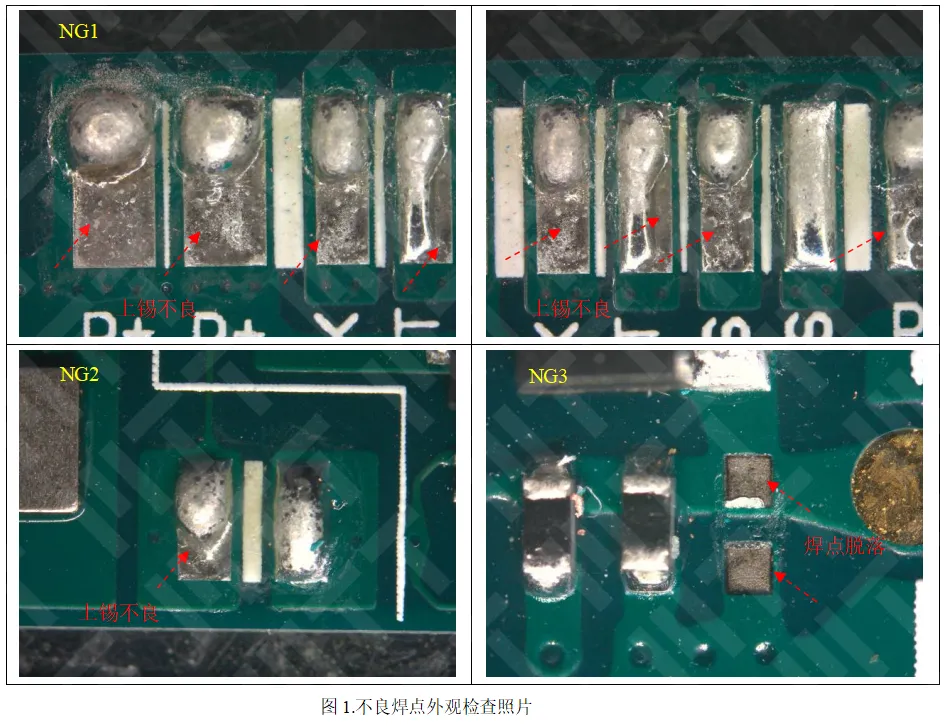
Choose 3 typical bad solder joints, optical inspection, the results are shown in Figure 1: most of the bad solder joints surface of the obvious wettling phenomenon, the color of the pads is blacked abnormal, the individual solder joints are removed, and the side of the welding disc is black.

Image

2. Surface analysis

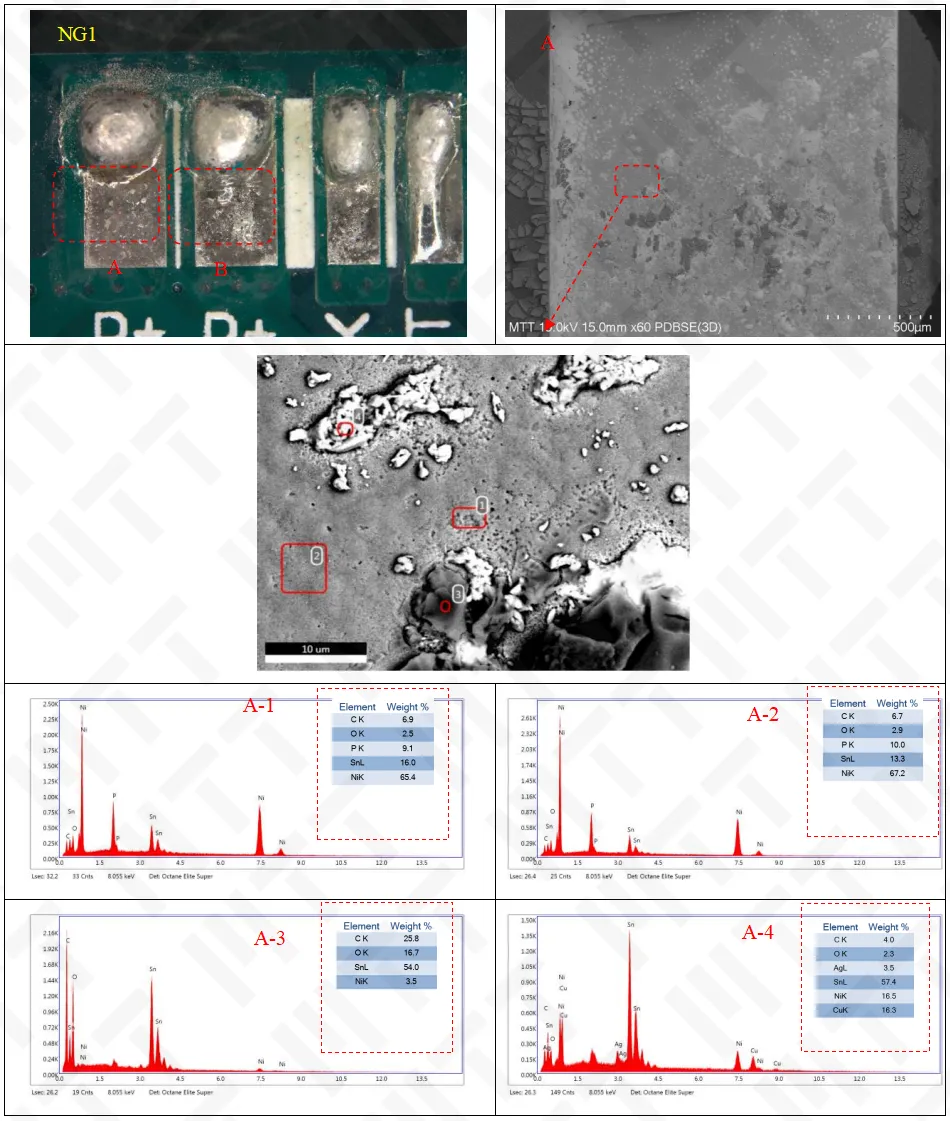
NG1: As shown in Figure 2, the surface of the damp rod wets the poor position, and the local presence of solder and flux residues; the wet surface contains C, O, P, Sn, Ni, Ni elements, the residual position of the solder contains C, O, Ag, Sn, Ni, Cu elements, and the residual position of the flux contains C, O, Sn, Ni elements, and no abnormal elements exist.

NG2, NG3: Wetting bad position morphology is similar to NG1, the composition contains C, O, P, Sn, Ni elements, no abnormal elements exist.

Image

Image


3. Profile analysis

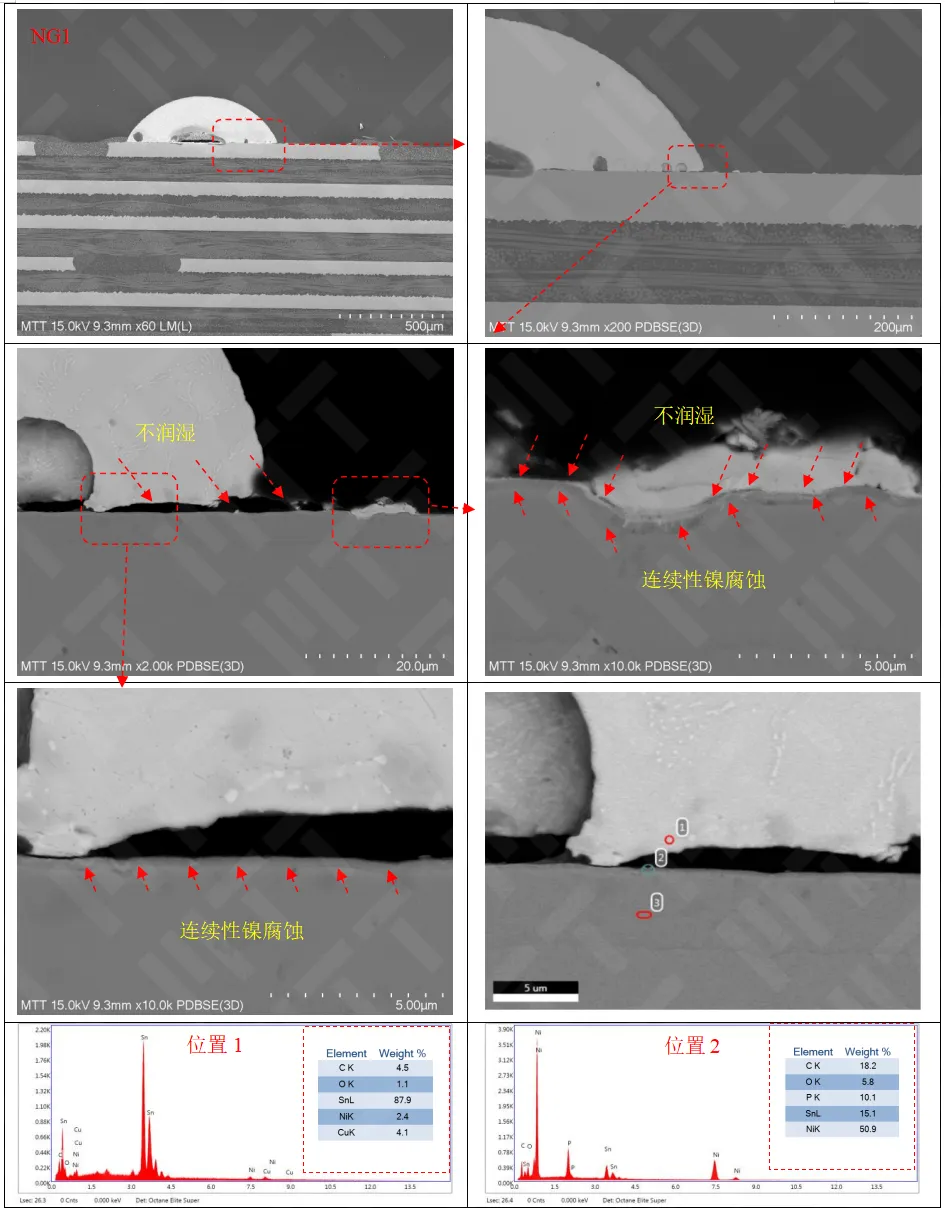
NG1: As shown in Figure 3, the slicing results show: after the bad solder plate slice, the solder residue position and no residual position are found to be non-wetting phenomenon; after amplification observation, there is a significant continuous nickel corrosion abnormality in the non-wetting position; Ni layer P content is 6.2wt%.

NG2, NG3: The slicing results are similar to the NG1 result, and the continuous nickel corrosion anomalies are also found in the non-wetting position.

Image

Image


4. Analysis and Summary

To sum up: PCBA solder joint welding bad reasons are mainly related to the continuous Ni layer corrosion, Ni layer corrosion, welding process, Au layer quickly melted in the solder, and as the welding substrate of the Ni layer can not form an effective metallurgical combination with the solder, that is, IMC layer, ultimately leading to the occurrence of welding spot wetting.

Ni layer corrosion is mainly due to the excessive oxidation of the surface of the nickel layer during the immersion of the PCB pad. The irregular deposition of large gold atoms and their rough grain is sparsely porous, resulting in the continuous "Galvanic effect" of the underlying nickel layer, which in turn causes the nickel layer to continuously oxidize, resulting in the continuous accumulation of undissolved nickel rust under the gold surface.

Summary: The cause of PCBA solder joint welding is mainly related to the continuous nickel corrosion of the PCB pad Ni layer, which causes the base Ni layer to be unable to form an effective metallurgical combination with the solder, that is, the IMC layer, which eventually leads to the occurrence of poor wetting of the solder.

5. Recommendation

Increase the quality control of PCB materials, such as weldability verification tests, to avoid the flow of abnormal materials into production.


Relevant cases
Still failing despite meeting IPC standards? The OSP film thickness tolerance vulnerability overlooked by 90% of factories
After undergoing two reflow temperatures, OSP pads exhibited severe solderability issues during wave soldering. Reducing the reflow temperature resolved the solderability problems. This paper analyzes the failure causes and mechanisms of solderability defects on OSP pads and proposes improvement recommendations.
The Truth Behind the 30% Surge in FPC Lead-Free Failure Rates | The “Invisible Killer” of Consumer Electronics
A certain FPC exhibited routing shallowing at certain locations, with both the edges and central areas of the defective samples showing this phenomenon. This paper will conduct a systematic failure analysis to identify the root cause of routing shallowing in the FPC.
Silicone Exceeding Limits = EU Sales Ban? With Global Regulations Tightening, Is Your Product Compliant?
Siloxanes are a class of organosilicon compounds containing Si-O-Si bonds, widely used in rubber, detergents, polishes, adhesives, sealants, and other fields. Due to the environmental and health risks associated with certain siloxanes, numerous countries and regions worldwide have enacted regulations to control their use.
Save Millions! Practical Tips for Avoiding Pitfalls in Metal Material Selection (Part 2)
In the previous article, “Choosing the Wrong Metal = Burning Money! A Guide to Avoiding Pitfalls in Metal Material Selection for Electronics (Part 1),” we established a knowledge framework for metal material properties and applications, and outlined the core steps for scientific material selection. However, theory must be tested by practice. This article will focus on the practical aspects: How can advanced inspection technologies provide reliable data support for material selection decisions? How can performance and cost be skillfully balanced in projects? Real-world case studies will reveal the consequences of improper material selection and the solutions to address them.
Choosing the Wrong Metal = Burning Money! A Guide to Avoiding Pitfalls in Metal Selection for Electronics (Part 1)
In electronic products, the selection of metal components directly impacts product performance, safety, and lifespan. From smartphone casings to aircraft engine blades, the scientific selection of metal materials stands as a core element in technological R&D. This article will explore the cost-effectiveness considerations in metal material selection in two parts, integrating laboratory testing techniques with engineering practice.
Flux compatibility issues with PCBA can actually lead to such severe consequences?!
A PCBA board for an audio product (using wave soldering) suffered burnout during operation. When using flux variant A, failure rates were high; after cleaning, the rate decreased slightly. Switching to flux variant B reduced the defect rate to zero. This paper will employ a series of professional testing and analytical methods to identify the root cause of the failure.
Online Customer Service
Business Consultation
Free Consultation
Report Inquiry
Back to Top
Contact Us
  • *Name:
  • *Contact:
  • *Email:
  • *Company/Organization/school:
  • *The location:
  • *Message information: