+86-400-850-4050





Didn't find what you were looking for?
Consult a professional engineer immediately for your service






















The heat transfer performance test evaluates the thermophysical properties of the coolant at different temperatures through thermal conductivity testing, heat dissipation efficiency comparison tests and specific heat capacity tests, providing data support for system thermal design.
Test Background
The core function of coolant is to transfer heat. Heat transfer performance parameters such as thermal conductivity and specific heat capacity directly determine its heat dissipation capacity under the same flow rate, and are the key basis for system design and selection.
Test Introduction
The heat transfer performance test evaluates the thermophysical properties of the coolant at different temperatures through thermal conductivity testing, heat dissipation efficiency comparison tests and specific heat capacity tests, providing data support for system thermal design.
Testing Objectives
Determine the thermal conductivity of the coolant at different temperatures
Verify whether the specific heat capacity meets the design expectations
Compare the heat dissipation efficiency of different coolants
Provide thermophysical property data for the CDU flow control strategy
Test Standards
ASTM D2717 Liquid thermal conductivity test
ASTM E1269 Specific Heat Capacity Test
YD/T 3982-2021 Requirements for heat transfer performance
Customer-defined Comparative Test Method
Applicable Products/Fields
Suitable for the selection of various liquid cooling working fluids, ratio optimization, and performance comparison and verification.
Test Content
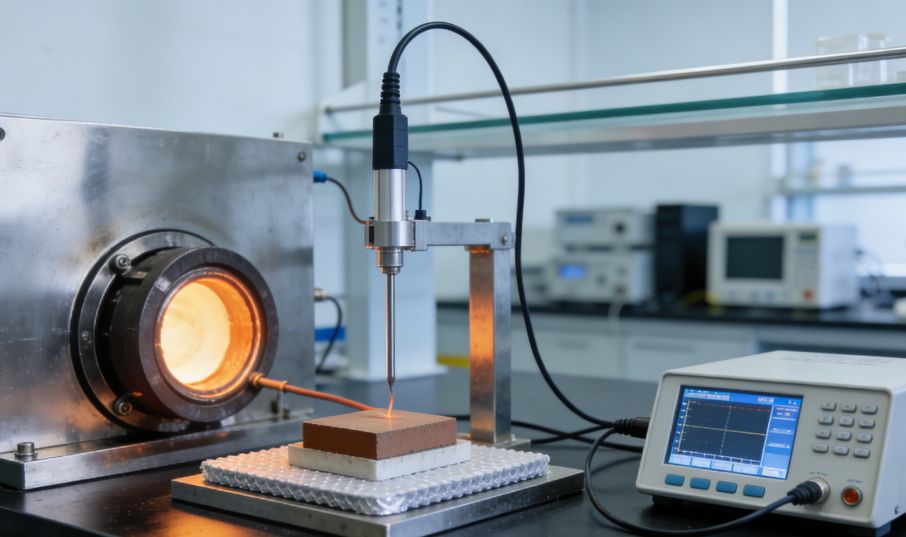
Thermal conductivity test: Measured by the hot wire method or the steady-state method
Specific heat capacity test: Differential Scanning Calorimetry (DSC)
Heat dissipation efficiency comparison: Comparison of temperature rises of different coolants under the same working conditions
Temperature-performance curve plotting: Changes in heat transfer performance at different temperatures
Project Advantages
High-precision thermal conductivity meter (±2% accuracy)
DSC specific heat capacity test (temperature range: -40°C to 100°C)
Provides a complete heat transfer performance data report
Laboratory Configuration
Thermal conductivity tester (hot wire method)
Differential scanning calorimeter (DSC)
Heat dissipation efficiency comparison test bench
Constant temperature circulating bath
FAQ
Q: How much higher is the thermal conductivity of water than that of ethylene glycol? A: At 25°C, the thermal conductivity of water is about 0.6 W/m·K, and that of ethylene glycol is about 0.25 W/m·K. Therefore, the heat transfer performance of pure water is better than that of ethylene glycol solution.

Maxin Testing Laboratory
Learn more about our company

Electronic Manufacturing Information Hub
See more exciting case studies

Video Channel
Watch more exciting videos









 Buildings A1, A3, and A5, Peking University Science and Innovation Park, Songbai Road, Bao'an District, ShenzhenBuilding 3, Xinyao Valley, 415 Changyang Street, Suzhou Industrial Park, Suzhou City1st Floor, Building 4, No. 39 Anzhi Street, Suzhou Industrial Park, Suzhou City