+86-400-850-4050





Didn't find what you were looking for?
Consult a professional engineer immediately for your service






















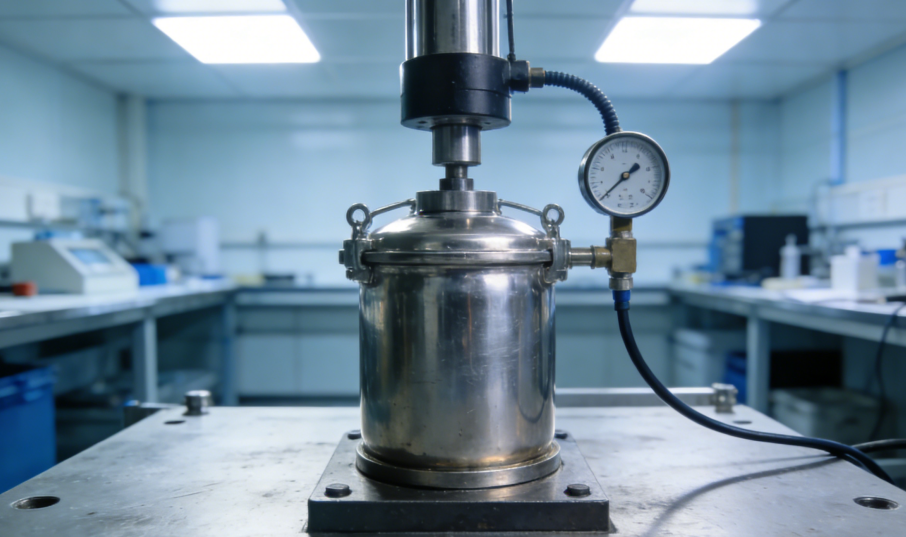
The sealing and pressure resistance test includes hydrostatic pressure resistance test, pressure cycle test and helium mass spectrometry leakage test to verify the sealing integrity and structural strength of the connection device under rated pressure and over-pressure conditions.
Test Background
The connection devices (Manifold, bellows, pipeline components) are one of the parts with the highest pressure and the greatest leakage risk in the liquid cooling system. The sealing and pressure resistance performance directly determines the safe operation of the system.
Test Introduction
The sealing and pressure resistance test includes hydrostatic pressure resistance test, pressure cycle test and helium mass spectrometry leakage test to verify the sealing integrity and structural strength of the connection device under rated pressure and over-pressure conditions.
Testing Objectives
Verify if there is any leakage and deformation under 1.5 times the working pressure
Determine the burst pressure limit to ensure a safety margin of ≥3 times
Detect micron-level leakage defects
Evaluate the fatigue life under pressure fluctuations
Test Standards
T/CESA 1249.2-2023 Technical specification for connection systems
GB/T 7939.2-2024 Test methods for quick-change connectors
ISO 19879 Test methods for hydraulic pipe connectors
Applicable Products/Fields
Suitable for water dividers, bellows, LCM, RCM, stainless-steel pipes, etc. in liquid-cooling systems.
Test Content
Hydrostatic pressure test: Maintain the pressure at 1.5 times the working pressure for 30 minutes
Burst pressure test: Increase the pressure at a uniform speed until rupture and record the burst value
Pressure cycle test: Cycle 10,000 times from 0.2 to 1.0 MPa
Helium mass spectrometry leak detection: Double leak detection in connected and disconnected states
Project Advantages
High-precision helium leak detection equipment, capable of detecting leaks at the 10⁻⁶ Pa·m³/s level
Pressure cycle testing can simulate start-stop life of more than 10 years
Provides burst pressure curves and failure mode analysis
Laboratory Configuration
Hydrostatic test bench (0-10 MPa)
Burst test system (automatically records the pressure curve)
Pressure pulse test bench
Helium mass spectrometry leak detector
FAQ
Q: Why is the burst pressure required to be ≥ 3 times the working pressure? A: Ensure that the pipeline will not burst during abnormal overpressure (such as accidental valve closure, water hammer effect), and gain time for safe pressure relief.

Maxin Testing Laboratory
Learn more about our company

Electronic Manufacturing Information Hub
See more exciting case studies

Video Channel
Watch more exciting videos









 Buildings A1, A3, and A5, Peking University Science and Innovation Park, Songbai Road, Bao'an District, ShenzhenBuilding 3, Xinyao Valley, 415 Changyang Street, Suzhou Industrial Park, Suzhou City1st Floor, Building 4, No. 39 Anzhi Street, Suzhou Industrial Park, Suzhou City