+86-400-850-4050





Didn't find what you were looking for?
Consult a professional engineer immediately for your service























What is the TSCA Regulation?
The
Toxic Substances Control Act (TSCA) is an important regulation for the
management of industrial chemicals in the United States, enacted by the
United States Congress in 1976 and entered into force in 1977. The
regulation, which is administered by the U.S. Environmental Protection
Agency (EPA), aims to comprehensively assess the environmental,
economic, and social impacts of chemical substances and prevent
“unreasonable risks” to human health and the environment. On June 7,
2016, the U.S. Senate passed the Lautenberg Act (H.R. 2576), which
introduced significant changes to the TSCA and strengthened the
management and regulation of chemicals, especially new and existing
chemicals.
TSCA control product range The TSCA regulations mainly regulate industrial chemicals, while the eight categories of chemicals that are regulated by specific regulations, such as food, food additives, and cosmetics unified by the United States Food, Drug and Cosmetics Regulations (FDA).
TSCA Directory The TSCA Directory is a dynamic list of more than 85,000 chemicals,
divided into public and confidential sections. Substances listed on the
TSCA list are existing chemicals, while those not listed are new
chemicals.
Management of Existing Chemical Substances The TSCA regulations impose four compliance obligations on the management of existing chemical substances: First,
the importer needs to make a self-declaration whether the chemical to
be imported meets the regulatory requirements of TSCA; Second, the importer makes an exemption statement for specific products; Before production, import, processing or use, it must submit an important new use declaration to the EPA 90 days in advance. The
fourth is that the manufacturer or importer reports the annual activity
volume, activity place, exposure information to the EPA every four
years.
Management of New Chemical Substances Typically,
new chemical substances are required to file a full Pre-Production
Declaration (PMN) with the EPA 90 days before commercial production or
import, unless it is an exemption declaration. After submitting a
complete pre-production declaration and passing the audit, the substance
will be added to the TSCA directory and become an existing chemical
substance.
TSCA requirements for hazardous chemicals The
EPA issued five final rules on January 6, 2021, to reduce exposure to
certain persistent (Persistent), Bioaccumulative, and Toxic Chemicals
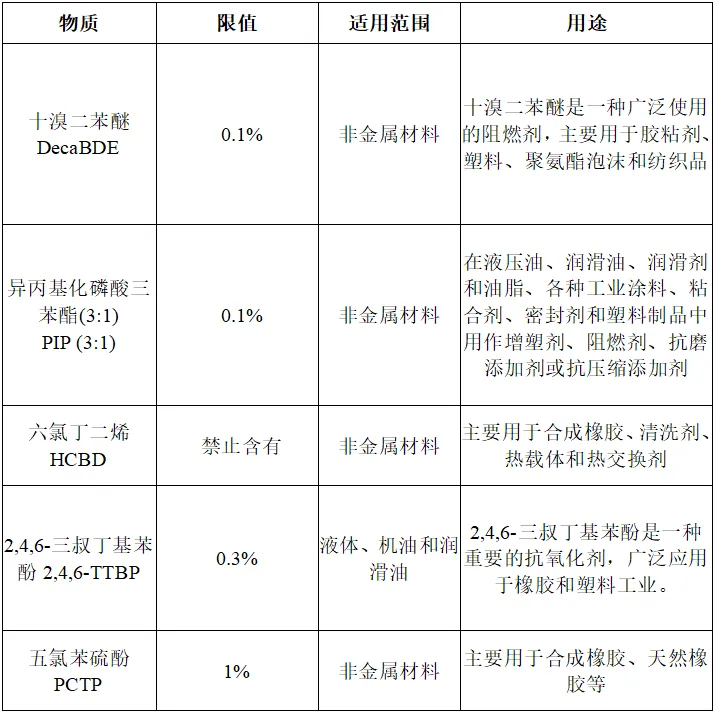
(PBT). At present, the specific control requirements for five PBT
substances are as follows:
Corporate obligations Companies
need to have a comprehensive understanding of the TSCA regulatory
requirements and clarify the regulatory details and restrictions and
reporting requirements for new and existing chemical substances. If the
product contains new chemicals, companies must submit a pre-production
declaration (PMN) to the U.S. Environmental Protection Agency (EPA) 90
days in advance, and the annual export volume of existing chemicals
exceeds 25,000 pounds (about 11.3 tons), and importers need to be
reminded to submit chemical substance data reports (CDRs). When goods
exported to the United States are imported into the country, companies
must provide a TSCA compliance or exemption statement. Companies also
need to pay special attention to the EPA’s regulatory rules for
perfluoroalkyl sulfonic acid (PFAS) and five PBT substances. At the same
time, enterprises need to cooperate with EPA's compliance monitoring,
take the initiative to self-disclosure, timely correct violations, and
continue to pay attention to regulatory updates, and flexibly adjust
compliance strategies to ensure the smooth entry of products into the US
market.
U.S. News Test Suggestions In
the United States, TSCA law enforcement inspections have been
normalized. Illegal enterprises will face product recall, shelves, fines
and other penalties, the circumstances are serious, the person in
charge of the enterprise may face fines or imprisonment. Enterprises
should promptly investigate the content of five harmful substances in
the products to ensure compliance with the requirements of the five
final rules. It is recommended to pay close attention to the latest
developments in the EPA on TSCA and adjust production and compliance
strategies in a timely manner. With
a dedicated technical team and extensive testing experience, Mercen
Testing can provide you with a comprehensive TSCA test solution to help
you easily meet the challenges of TSCA regulations and ensure product
safety and compliance.





Maxin Testing Laboratory
Learn more about our company
Electronic Manufacturing Information Hub
See more exciting case studies

Video Channel
Watch more exciting videos








 Buildings A1, A3, and A5, Peking University Science and Innovation Park, Songbai Road, Bao'an District, ShenzhenBuilding 3, Xinyao Valley, 415 Changyang Street, Suzhou Industrial Park, Suzhou City1st Floor, Building 4, No. 39 Anzhi Street, Suzhou Industrial Park, Suzhou City